
Discover the Invisible Threads Between Your Sandwich and the Sea
Shared from my Enchanted Planet Blog... with a little Substack intro.

Do you ever get the sense that life is one big interconnected web? Every little thing we do has an effect on the whole. That’s the way my Celtic ancestors saw things. Probably yours too.
Wiggle your little finger and a galaxy across the universe responds. But, much as I like to look at the big picture, that’s a much bigger picture than I’m sharing with you today.
Let’s start right here on our own little planet Earth.
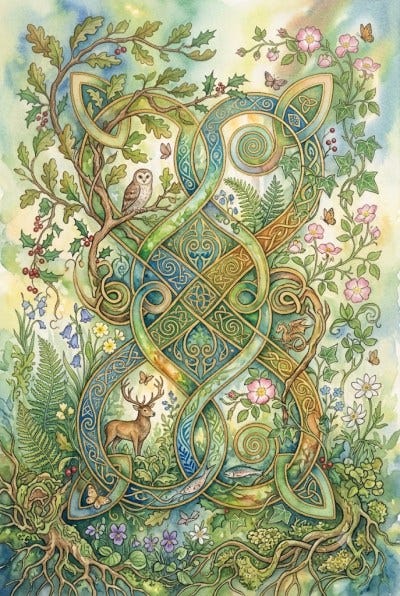
Picture yourself beside a creek in the redwoods, watching a single fallen leaf drift downstream.
It twirls around a rock, disappears beneath a fern, catches an eddy, and continues on its way. That little leaf is part of a web. It isn’t traveling alone. It’s carrying minerals from the forest, feeding insects, nourishing fungi, and eventually contributing—however infinitesimally—to rivers, estuaries, and finally the ocean.
Nature Doesn’t Believe Anything is Separate
Only humans seem to have mastered that illusion.
We separate the food on our plate from the soil that grew it, from the people who harvested it, from the water that nourished it, from the costs to our healthcare system, and from the generations who will inherit whatever kind of planet we leave behind.
We imagine our lunch ends when the plate is empty.
Mother Nature smiles and says, “Oh no, dear. It has only just begun.”
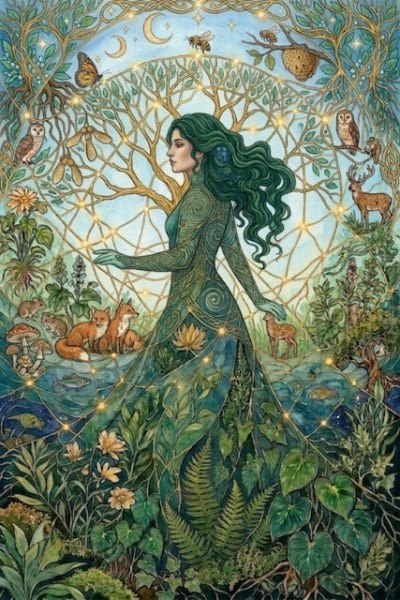
Maybe this is more obvious to me than it is to most people, because I have a dyslexic brain.
As a child, I struggled with reading and math, but dyslexia turned out to be an unexpected gift. It helps me see connections, patterns, and the larger picture rather than getting lost in the details. Sharing what I see has become a big part of my life’s work.
Ask me to multiply double digits in my head, and I may need another cup of tea. But ask me how healthcare, education, politics, climate, forests, economics, chronic disease, and hamburgers are connected…
…and suddenly I see an enormous tapestry.
I’ve spent most of my life assuming everyone else saw it too.
Apparently not.
Our educational system trains people to think in tidy little boxes. Health belongs over here. The economy goes over there. Politics is somewhere we’d rather avoid. The environment is another department entirely. Then there’s dinner, as though dinner has nothing to do with any of the others.
But every meal sends ripples through the entire web of life.
I’ll admit, it can sometimes feel like a burden to be constantly aware of how interconnected everything is, but on the other hand, it’s a truth that we all need to consider….
One Hamburger, One Astonishingly Interconnected Story
Consider one ordinary hamburger.
Most people think they’re buying lunch. In reality, they’re also buying water use, land use, transportation, packaging, methane emissions, manure runoff, antibiotic use, labor practices, healthcare costs, political subsidies, wildlife habitat, and yes—even what happens hundreds of miles away in our oceans.
Excess nutrients from industrial agriculture create vast ocean dead zones where little marine life can survive. Forests are clear cut to make room for grazing and feed crops. Countless animals and plants disappear—even driving some to extinction.
Crowded factory farms create conditions where viruses spread like wildfire. Routine antibiotic use fuels resistant bacteria and the rise of superbugs.
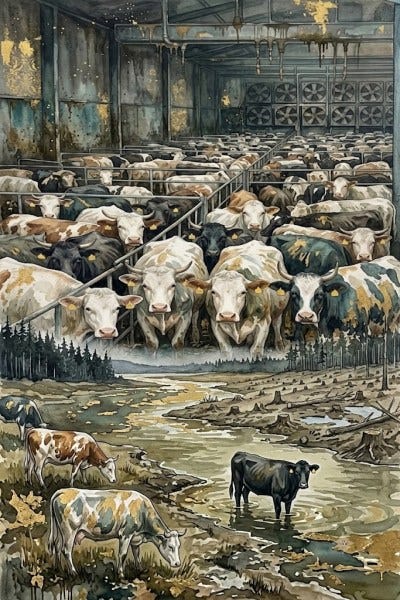
Meanwhile, our healthcare system strains under chronic diseases linked to our dietary patterns. Insurance premiums climb. Tax dollars are redirected. Families shoulder the burden. Communities feel the ripple effects.
One sandwich. One astonishingly interconnected story.
None of this is about blame. It’s about awareness. About learning to see the patterns that have been there all along—the invisible threads connecting our choices to our health, our communities, the living Earth, and to generations yet unborn.
Every meal is part of a story far larger than our own plate.
As Within, So Without—And Also the Reverse
One of my favorite magical principles is as within, so without. We usually apply it psychologically: heal yourself and your outer world begins to change. Beautiful. True. But it works the other way as well.
As without, so within.
When we pollute rivers, eventually we pollute ourselves. When we strip nutrients from the soil, our food contains fewer nutrients and our health suffers. When forests disappear, climate changes.
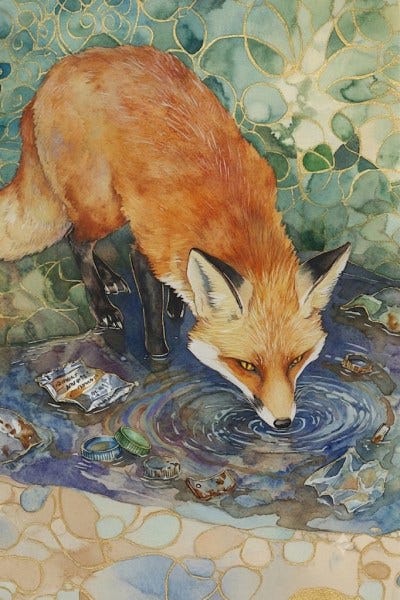
When climate changes, crops struggle. When crops struggle, food prices rise. When food prices rise, families experience stress. Stress affects health. Health affects relationships. Relationships affect communities. Communities shape nations. The circle keeps turning.
Our Ancestors Already Knew This
The ancient Celts and other indigenous cultures understood this instinctively. Nothing existed in isolation. Every action was part of a relationship. Every relationship carried responsibility. Every responsibility carried blessing. It was all woven together like a massive Celtic knot.
Modern life has become remarkably efficient at hiding consequences.
You don’t see how much water was used to produce your lunch. You don’t hear the chainsaws clearing pasture land. You don’t smell the polluted streams. You don’t witness the exhausted soil. You certainly don’t receive a receipt listing the environmental and health costs alongside the sales tax.
If we did, I suspect we’d shop differently.
The Hopeful Side of the Ripple
Here’s the encouraging part: the opposite is also true.
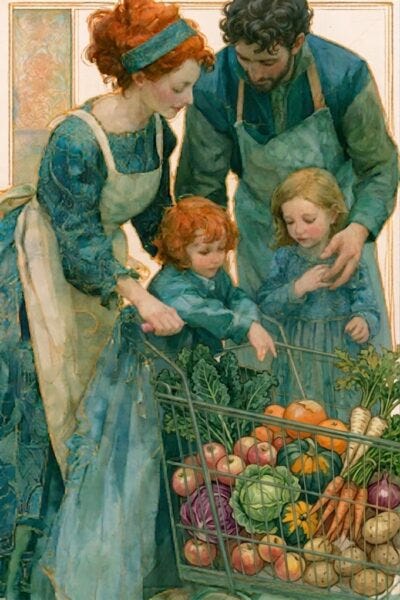
Every bowl of lentil soup. Every colorful salad. Every bean chili. Every apple. Every handful of walnuts. Every meal built from plants sends a different ripple into the web.
It requires fewer resources, creates less pollution, uses less water, leaves more room for wildlife, and supports healthier bodies, easing the strain on healthcare systems over time. And when those plants are grown organically, the ripple widens even further—protecting farmworkers, fish, frogs, birds, butterflies, bees, and the long-term fertility of the soil itself.
It has never really been a simple choice between plant and animal foods, or organic and conventional. It is all one web. Every decision, however small, touches the soil, the water, the workers, the wildlife, and the generations still to come.
Each of these choices reminds us that we are participants in life, not merely consumers passing through it.
No one has to become perfect. Perfection is exhausting. Progress is delicious.
The goal isn’t earning some imaginary gold star for living an ethical lifestyle. The goal is remembering that every small choice is a vote for the kind of world we want to live in.
We are not separate from the forests. We are not separate from the oceans. We are not separate from one another.
A creek taught me that years ago.
One leaf. One current. One river. One ocean. One living planet. One magnificent web.
A Few Questions to Carry Into This Week
Instead of asking “what do I feel like eating today,” try asking:
What kind of world does this meal support?
How can I nourish both my body and the Earth with the same choice?
Where did this food begin its journey?
Who—or what—benefits from my purchase?
What’s one small plant-based swap I could make this week that feels joyful rather than restrictive?

Changing the world rarely begins with grand speeches. Sometimes it begins with lunch. And sometimes, changing lunch changes far more than we ever imagined… maybe even that galaxy on the other side of the universe.
If you’re curious about shifting toward a more planet-friendly lifestyle, you’ll find lots of resources and personal guidance here: https://www.plantbasedvegancoach.com/